Night in the Bog: Reflections of the Milky Way and the Howling of Wolves
August and September are my favorite months to experience nature in Estonia—not just because of the misty mornings in the bogs or the vibrant autumn colors, but because we have dark nights back again, making it possible to photograph the starry sky and the Milky Way. Unfortunately, clear nights are often a rare sight here in Estonia during this time of year. The sky is cloudy much of the time, which leaves few opportunities for night photography. The beauty of the starry sky is best captured when there is no moonlight to interfere, and this ideal window lasts only about a week each month. Everything has to align perfectly. One day in September, following a long stretch of cloudy weather, nature finally offered hope. I checked various weather forecasts, and it was clear—I had to go. I packed my hiking and photography gear and headed out to the bog for the night. The experience that awaited me there was truly extraordinary!
I like to take my time on my photography trips. If I’ve planned to arrive at the bog by a certain hour, I always take an extra hour or so—just in case I happen to spot something or someone interesting along the way that’s worth photographing. I’m a Virgo, which probably explains why I do things this way; I’d much rather arrive early than late. I’ve even managed to put my friends in awkward situations—like when they’ve ended up arriving late to their own birthday parties! 🫣
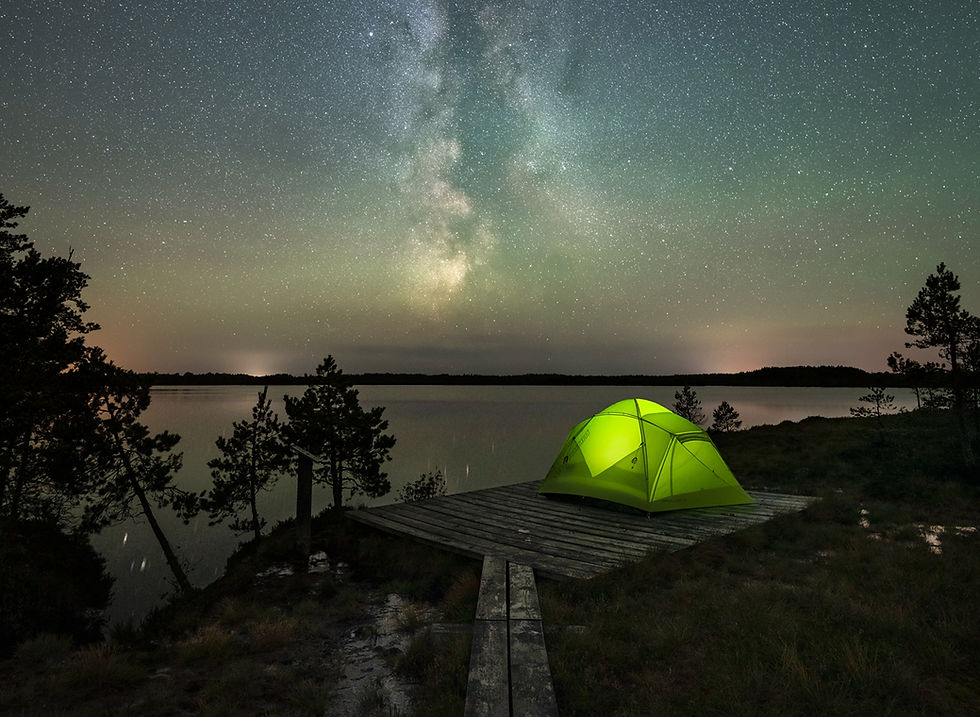
So I took time for myself to wander in calm pace. There were no wodden paths or other paths leading to the bog where I intended to take photos. It was a wild area; to reach the bog itself, I first had to hike about 600 meters through the forest. After that, I covered another kilometer or so on bogshoes to reach the bog pools—the spots where I had planned to take specific photographs. Once I arrived, I set up my hammock, where I hoped to get a few hours of sleep in between my night-time photography sessions. The forecast for the morning promised fog and high-altitude clouds, so I needed to wake up about an hour before sunrise to capture it all. With camp set up, I began preparing for the night’s shoot.


PHOTO PLANS
My primary goal was to photograph the Milky Way alongside with photogenic bog islands and their reflections. I also hoped to experience a misty morning, if the conditions would line up. I brought two cameras with me: a Sony a7RV and a Sony a7IV. On the Sony a7RV, I had the SIGMA 14mm F/1.4 DG DN | Art lens, intending to capture a time-lapse. In fact, this was also the reason I arrived at the bog early—I wanted to capture a day to night timelapse to begin at sunset and transition seamlessly into the night. I had attempted this approach a couple of times before, but things hadn't gone according to plan. For the second camera, the Sony a7IV, I used a SIGMA 16-28mm F/2.8 DG DN | Contemporary lens. With this setup, I captured various single shots throughout the night, while the Sony a7RV was capturing the time-lapse.


NIGHTLIFE COMES ALIVE
The time from sunset until darkness in large part is just waiting. Yet, this waiting has a unique kind of excitement to it. As it grows steadily dimmer, the pace seems to slow down—everything appears to come to a standstill. Then, suddenly, darkness arrives, and things are far from standing still. Events begin to unfold, and the natural world’s nightlife springs into action. I still remember the first few times I spent the night alone in a pitch-black bog. At first, it was unsettling, but eventually, you get used to it and become friends with the darkness. Life has taught me that it is often better to simply become friends with one’s own fears.
First, flocks of ducks began landing on the bog lakes. At times, I worried they might fly straight into me in the dark—fortunately, that didn’t happen. Whenever I switched on my headlamp, the ducks would take off again, only to return a short while later.
At one point, I spotted an owl circling nearby. I’m not particularly well-versed in identifying owls, but it might have been a Short-eared Owl. The last time I was here taking photos, an owl was circling around in much the same way.
Then came one of the most remarkable moments of the night: suddenly, the howling of a wolf pack began to echo from the distance. It lasted for about five minutes in total—the howling would grow louder and more intense, then subside again. Later, I checked the map and realized the howling might have come from about 1–1.5 kilometers away. I had heard a wolf pack howling in a similar way once before, but they were further off then, so the sound wasn't as intense. Experiences like these always make me reflect on just how incredible and rare the moments I get to witness during my photography trips truly are. Things happen at night—but I still had some photography to do.
HOW DO I CAPTURE A NIGHT PHOTO?
I thought I’d explain a bit about how I captured one of my night photos. I’ve already shared a few shots from this trip on social media, and I’ve received questions asking if I’d be willing to share how I captured this particular image. I’m more than happy to do so—if you’re interested in the technical side of things, or perhaps in what was going through my mind at the time, then this next paragraph is for you.
First and foremost, I focus on composition. To me, composition is the most important element; yet, over the years, I’ve come to realize that it is also the most complex to master. Ultimately, everything comes down to what the photographer sees. There are countless ways to arrange the visible elements within a frame. Learning about composition is a lifelong process—as long as you are engaged in any form of visual art, you are constantly learning. In short, if the composition is off, it doesn’t matter how technically perfect your shot is. Simply put, the photo just won’t look good; if the composition fails, the image falls apart as a whole, and the viewer’s gaze ends up wandering aimlessly around the frame.
In the photo you see below, it was important to me that the trees had "breathing room" around them—specifically to the left and right of the bog islands. In the landscape-format photo, I made sure to leave some "breathing room" above the trees also, ensuring they weren't positioned too close to the edges of the frame—otherwise, it might feel as though nature had been placed in a cage. I also took care to avoid having isolated elements intrude into the frame from the edges; such objects tend to distract the viewer. The only thing that still bothers me slightly is that the branches of the trees on the middle and right-hand bog islands overlap, almost as if they have grown together. It is also ideal to have some breathing room between the bog islands themselves if possible, keeping them distinct from one another. As I mentioned earlier, I suppose I’ll be learning for the rest of my life 🙂.
I decided to position the Milky Way further to the left; since the largest bog island on the right dominates the scene, placing the Milky Way on the left helps balance the entire composition.
Regarding the reflection, I aimed to place the camera as close to the surface as possible—the closer you are to the water's surface, the more symmetrical the reflection becomes. However, I couldn't go *too* low, as the various plants characteristic of the bog landscape would have ended up in the foreground of the frame; finding the perfect height was key. The photo above shows the final positioning I chose for the camera. I have noted out a few important technical notes below:
- I always use a tripod for night photography.
- Settings: f/1.8, 13 seconds, ISO 5000 (if the exposure time is longer at 14mm focal length, there will be star trailing; I prefer them to appear as pin point stars).
- I set the focus on the stars using manual focus. I locate brighter stars in the sky and zoom in digitally—a feature built into all modern cameras. As I adjust the focus, I watch the LCD screen to ensure the stars appear as sharp points.
- I set the screen brightness to the minimum level. Furthermore, the camera does not automatically display the image on the LCD screen after each shot; I view it manually only when I choose to. This helps conserve battery life.
- "Long Exposure Noise Reduction" is turned off. When enabled, the camera captures a "blank" black frame—lasting as long as the original exposure—to reduce noise. This is time-consuming, so I avoid using it. Nowadays, there are many superior and more convenient ways to reduce noise in photos during post-processing. - I also configure the cameras self-timer to 2 seconds—sometimes even 5 seconds—before actually taking the shot. Naturally, I take my hands off the camera after the moment I press the shutter. This ensures the photo remains sharp, preventing any vibrations—which I might otherwise cause by holding the camera—from ruining the image.
- When shooting at night, I generally use a lens heater, which wraps around the lens to keep the glass from fogging up. It’s usually quite moist at night; if you leave your camera out for hours—for instance, while shooting a time-lapse—without a heater, you’ll likely end up ruining the entire timelapse. Lens heaters cost roughly €20–€50, and I highly recommend getting one.
If you’d like to read more about how to better prepare for night photography, I’ve written a separate blog post on the subject; you can find the link at the end of this post.
But for now, let’s take a break from the technical part and get back to the adventure.
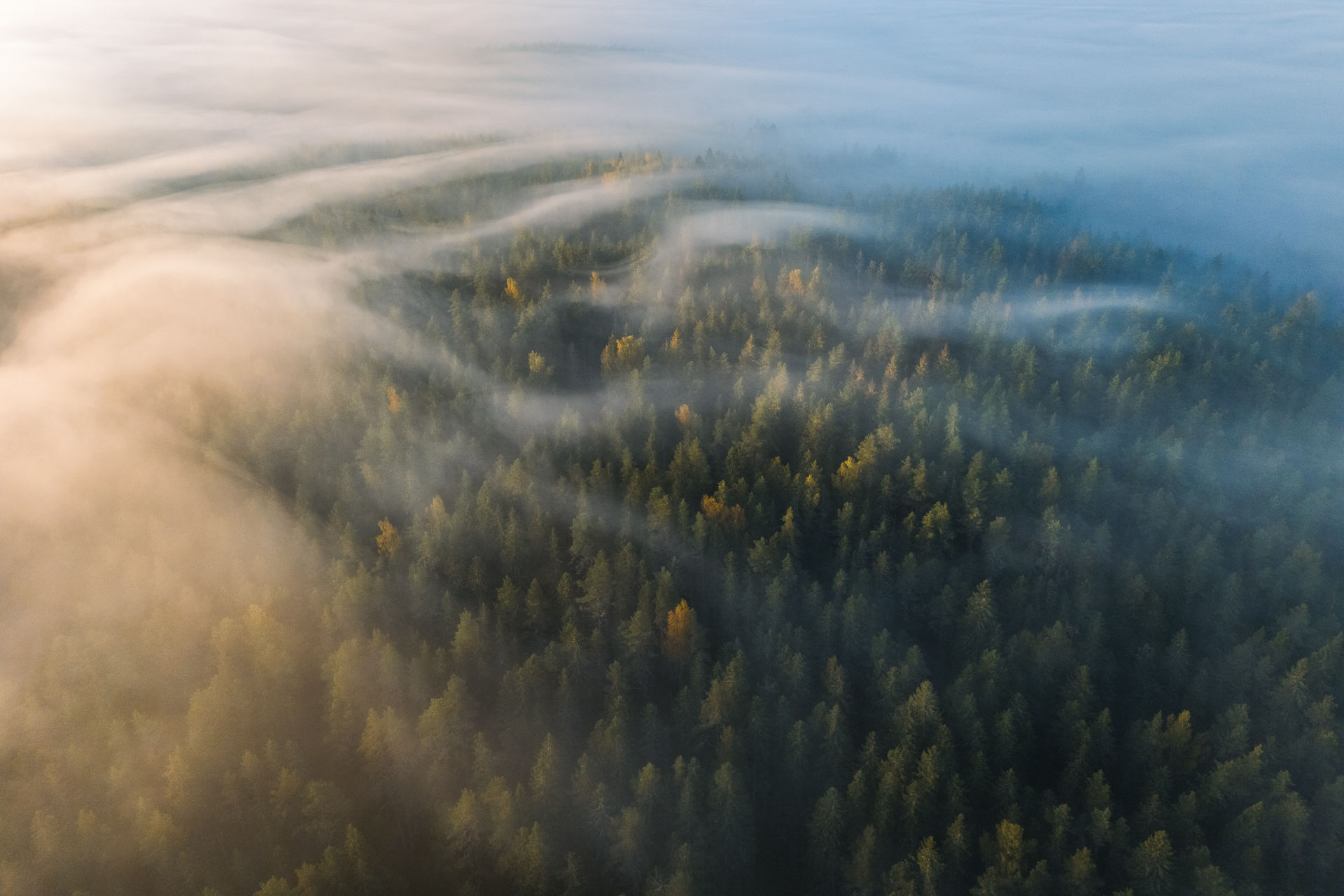
Slowly, fog began to form over the bog, making the surroundings feel even more mystical. I captured a few single shots. At one point, some clouds appeared in the sky, adding an extra layer of interest to the photos. Eventually, I felt that I had captured what I needed, and I began to feel a bit tired. The timelaspe camera was scheduled to shoot until around 4 a.m.—and then I settled into my hammock to sleep. After such an experience, it was hard to fall asleep at first, but eventually, I drifted off. It was around 1 o'clock. My alarm was set for 5:45 a.m. so I could take in the morning scenery.


THE MAGIC OF MORNINGS
Waking up in the bog is absolutely amazing. There’s always a little thrill—wondering if there will be fog, how much of it will be there, and what the clouds and other conditions will look like. This time, there was fog, along with some high-altitude clouds. It wasn’t exactly what I had hoped for, but my time spent in nature has taught me that fewer expectations lead to fewer disappointments.
After a quick coffee and breakfast, I headed back to the bog lakes where I had taken photos during the night. The lakes were about 100 meters from my hammock.
On the way to the pools, I suddenly spotted some animal droppings among the bog vegetation. I realized it was wolf scat—only about 50 meters from my hammock where I slept. Whether it had been there for a while, or if wolves had walked past very close to me during the night, I can’t say for sure. I’m not exactly an expert on such things. Let’s just say it certainly gave me something to think about. 🙂

Upon reaching the bog pools, I was greeted by magical scenery. The sun was set to rise in about 25 minutes. This gave me some time to calmly consider what might happen ahead. One of the skills a photographer should possess is the ability to look a bit into the future—to anticipate what might unfold and, based on that, decide where to shoot, how to approach the shots, and so on.
I decided not to go back for the camera I had set up for a time-lapse; the conditions were simply too spectacular, and I didn’t want to waste any time. Besides, the camera was on the other side of the bog pools—retrieving it would have taken me about 10–15 minutes.
In truth, there wasn’t much to think about. I took out my versatile, lightweight SIGMA 20–200mm F/3.5–6.3 DG DN | Contemporary lens and began shooting. At 20mm, it’s wide enough to capture wide landscape scenes, while 200mm offers enough reach to zoom in on specific details.


At one point, I heard the loud calls of common cranes in the distance. I had actually heard them earlier that morning too, but hadn’t paid much attention. Suddenly the calls grew closer—and then closer still. Before long, I saw them flying toward me from afar in a V-formation. One flock passed over the bog islands in front of me, and I managed to capture them in a photograph, along with the islands and their reflections. Even now, as I write this, those powerful calls of the cranes still echo in my ears, and every emotion and intense moment remains vivid in my memory.
About five minutes later, the whole scene repeated itself. This time, one flock flew directly overhead, while another passed over the bog islands again. These are the moments when a photographer’s mind must shift into high gear—anticipating, as I mentioned earlier, exactly how to capture the shot. Below, you’ll find a few of the photos I managed to capture.


Following such spirited and powerful moments, the sun also began to rise quietly from behind the trees. The first light started to fall upon the landscape, creating further picturesque views.


After those moments, I headed over to my time-lapse camera on the other side of the bog pools. Light began to gently fall upon the bog islands, and I imagined how such soft light, combined with the fog, might look truly striking. Two of the resulting photos even made it into my 2027 photo calendars!


Later, I captured a few more shots with my drone and took a moment to reflect on what had just happened.
I had come to this bog for just a couple of night shots—images that had been on my mind for the past six months. But I ended up with so much more—not just photographs, but a series of breathtaking moments. These are the kinds of moments that truly make you feel alive.
Once the sun was high in the sky and my photography was done, I headed back to my hammock. I packed up my camp and began to make my way out of the bog. I had promised my wife and kid that I would bring back some wild cranberries, and there were a lot of them in the bog. A perfect vitamin boost to wrap up this photography adventure.



Comments